
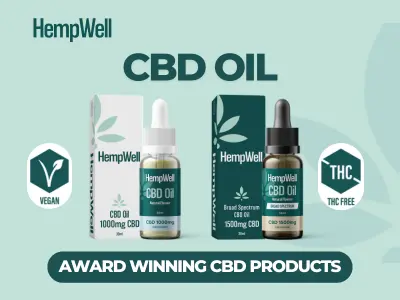
CBD isolate oil contains one thing from the hemp plant: cannabidiol. Broad spectrum oil keeps the plant’s other cannabinoids and terpenes but has the THC removed. In Ireland both must be THC-free, both are sold as food supplements rather than medicines, and the honest answer to “which is better?” is that it depends on you. Isolate is the simplest, most predictable and best-tasting starting point; broad spectrum is the fuller plant profile some people prefer, backed by an idea called the entourage effect that is interesting but not proven.
This guide explains what each oil actually contains, why full spectrum is not sold here, what the research does and does not say about the entourage effect, how the two compare on taste and carrier oils, what they mean for drug tests and driving, and how to pick a starting point. We make both ranges by hand at our laboratory in York Science Park from hemp grown on our own farm in Europe, and we would rather you chose the right bottle than the dearer one.
Table of Contents
- What CBD isolate oil is
- What broad spectrum CBD oil is
- Full spectrum, and why we do not sell it in Ireland
- The entourage effect: what the evidence shows
- Isolate vs broad spectrum at a glance
- Drug tests, driving and THC-free oils
- How to choose your starting point
- How we do it at HempWell
- Frequently asked questions
What CBD isolate oil is
CBD isolate is cannabidiol that has been separated from everything else in the hemp extract through extraction, winterisation and distillation until only a crystalline powder of 99%+ CBD remains. Dissolve that powder in a carrier oil and you have an isolate oil. Our Pure CBD Oil range is exactly that: CBD isolate, organic MCT coconut oil, and an optional natural flavouring. Nothing else is in the bottle, and because the starting material is a single purified compound there is no THC to remove in the first place.
Isolate has three practical advantages. It is the most predictable form of CBD, because the only active ingredient is the one on the label. It is close to tasteless, so the natural flavour disappears into a coffee or under the tongue without the earthy hemp note that puts some people off. And it is the easiest to measure: a 1000mg bottle holds 33mg of CBD per millilitre, a 1500mg bottle 50mg per millilitre, and every bottle ships with a graduated pipette so you measure in millilitres rather than counting drops. It is the range we suggest for almost everyone starting out.
What broad spectrum CBD oil is
Broad spectrum oil starts from the whole hemp extract rather than a purified powder. The extract keeps the plant’s minor cannabinoids, such as CBG and CBC, and its terpenes, the aromatic compounds that give hemp its smell, and then has the THC removed by a further processing step. Our Broad Spectrum CBD Oil range uses that THC-free extract in a hemp seed oil carrier, in the same three flavours and strengths from 500mg to 4000mg.
The trade-offs are the mirror image of isolate. You get the fuller plant profile, which is the whole point for people who want it, at the cost of a stronger, earthier taste (the hemp seed carrier adds to that) and slightly less precision, because the minor cannabinoids vary a little from harvest to harvest even though the CBD content is standardised. Some of our customers tell us they notice more from broad spectrum than from isolate at the same strength. Others notice nothing beyond the CBD. Both reports are real, and the next section explains why neither settles the question.
Full spectrum, and why we do not sell it in Ireland
You will also see “full spectrum” oils advertised, mostly from abroad. Full spectrum keeps everything in the plant, including THC. That is a problem in Ireland. The Food Safety Authority of Ireland is clear that CBD itself is not a controlled substance, but that THC is a narcotic under the Misuse of Drugs Act 1977 and that, apart from hemp seed products, “there is no regulatory threshold or tolerance for the presence of THC in food”, so a food “containing any level of THC is classed as a narcotic drug” (FSAI, CBD and other hemp products). The 0.2% figure you may have read about is the limit for THC in the hemp crop in the field, not a permitted level in a bottle on a shelf. Our guide to whether CBD is legal in Ireland goes through the detail.
That is why we make no full spectrum products for any market. Customers who have switched from a full spectrum oil bought elsewhere to our broad spectrum generally describe a very similar experience: the plant profile is close, minus the THC. If you are moving across, start at the same strength you were taking. Where another brand labels strength as a percentage, our 1500mg oils are the equivalent of 5% CBD and the 3000mg bottles 10%, both in 30ml.
The entourage effect: what the evidence shows
The entourage effect is the idea that hemp’s compounds work better together than any one of them does alone. The term was popularised in a 2011 review in the British Journal of Pharmacology, which set out the case that cannabis terpenoids “display unique therapeutic effects that may contribute meaningfully to the entourage effects of cannabis-based medicinal extracts”, and concluded, carefully, that “phytocannabinoid-terpenoid synergy, if proven, increases the likelihood” of new products from the plant (Russo, 2011). The phrase “if proven” matters: it was a hypothesis then and it is still largely a hypothesis now.
The best human data come from epilepsy, where CBD is used at prescription doses far above anything in a supplement. A meta-analysis of 670 patients compared CBD-rich extracts with purified CBD. More patients on the extracts reported some improvement (71% against 46%), and they used much lower average doses, but when the standard clinical threshold of a 50% reduction in seizures was applied there was “no difference” between the two (Pamplona et al., 2018). The authors suggested the difference is “likely due to synergistic effects of CBD with other phytocompounds (aka Entourage effect), but this remains to be confirmed in controlled clinical studies”. That is an honest summary of the field: suggestive observational data, no controlled trial that settles it, and nothing at all at food-supplement amounts.
So we do not claim broad spectrum “works better”. We say the strongest evidence is for CBD as a compound, which both ranges deliver in standardised amounts, and that the extra plant compounds in broad spectrum may or may not add something for you. Our Scientific Advisor, Professor Mike Barnes, takes the same line: start with the thing the evidence supports and treat the rest as a personal experiment.
Isolate vs broad spectrum at a glance
| Pure CBD Oil (isolate) | Broad Spectrum CBD Oil | |
|---|---|---|
| What is in it | CBD isolate (99%+ purity) only | CBD plus minor cannabinoids and terpenes, THC removed |
| THC | 0%, none present | 0%, removed and verified by lab report |
| Carrier oil | Organic MCT coconut oil | Hemp seed oil |
| Taste | Almost nothing (natural), or peppermint / mixed berry | Earthy and hempy, softened by the same flavours |
| Strengths (30ml) | 500mg to 4000mg | 500mg to 4000mg |
| Predictability | Highest: one active ingredient | CBD standardised; minor compounds vary by harvest |
| Who tends to prefer it | First-time users, anyone sensitive to taste, people who mix it into drinks | People who want the fuller plant profile or are moving from cannabis / full spectrum |
| Vegan | Yes | Yes |
Everything else is the same: the same 30ml bottle, the same graduated pipette, the same strength maths (milligrams divided by 30 gives milligrams per millilitre), and the same price for the same strength, with subscriptions saving 20% on either.
Drug tests, driving and THC-free oils
Because neither range contains THC, there is nothing in either bottle that a workplace or roadside test is looking for. Standard tests screen for THC and its metabolites, not for CBD. In a Johns Hopkins study that gave healthy adults 100mg of pure CBD by mouth and vapour, “only 1 out of 218 urine specimens screened positive” at the most sensitive cut-off and none confirmed positive, while a CBD-dominant cannabis product that also contained 3.7mg of THC did produce confirmed positives (Spindle et al., 2020). The lesson is not isolate versus broad spectrum; it is THC-free versus THC-containing. Our guide to CBD and drug tests covers the Irish position, and the driving guide explains what Garda roadside testing measures.
The only way to know a broad spectrum oil really is THC-free is a laboratory report. Ours are published for every product on our lab reports page, so you can check the THC line yourself before you buy.
How to choose your starting point
- New to CBD? Start with a low strength of Pure CBD Oil. It is simple, precise and tastes of almost nothing. A 500mg or 1000mg bottle lets you begin at 10 to 20mg a day and work up with the pipette; most people settle somewhere between 33mg and 66mg a day, which is a full 1ml pipette of the 1000mg, 1500mg or 2000mg oils. The dosage guide walks through it.
- Finished a bottle and want more from it? You have two levers: go up a strength in isolate, or try the same strength in broad spectrum and compare. Change one thing at a time, otherwise you will not know which made the difference.
- Drawn to the fuller plant profile, or moving from cannabis or a full spectrum product? Start with broad spectrum directly. The 1500mg Broad Spectrum CBD Oil is the best-selling bottle in that range and a sensible middle strength. If you are stepping down from cannabis, our guide on CBD and cannabis withdrawal covers that honestly.
- Sensitive to taste, or mixing it into drinks? Isolate, natural flavour. Broad spectrum’s hemp seed carrier is noticeable in a coffee.
- Taking medication? Either range can interact with some medicines, because the CBD does, not the plant profile. Read our interactions guide and ask your pharmacist first.
Whichever you pick, stay within the 70mg a day guideline for healthy adults that we work to across the range, and give a bottle two to three weeks of consistent use before judging it.
How we do it at HempWell
Both ranges start on our own hemp farm in Europe, grown from EU-certified seed, and are extracted with supercritical CO2 before the isolate is purified or the broad spectrum extract has its THC removed. The oils are then blended, bottled and labelled by hand at our laboratory in York Science Park, and each product is independently lab tested, with the reports published on our lab reports page rather than hidden behind a QR code. The range was developed with guidance from Professor Mike Barnes, and more than 2,000 verified customers have reviewed it. We deliver across Ireland with DPD, free over €50, dispatched the same day before 1pm.
Frequently asked questions
Is broad spectrum CBD stronger than isolate?
Not in CBD terms: a 1500mg bottle of either contains 1500mg of CBD. Broad spectrum also contains small amounts of other cannabinoids and terpenes, which some people feel adds to the effect. The evidence for that, the entourage effect, is suggestive rather than proven, so treat it as something to test for yourself rather than a guarantee.
Does broad spectrum CBD contain THC?
Ours does not. The THC is removed during processing and each product is checked by an independent laboratory; the reports are on our lab reports page. In Ireland any detectable THC would make the product a controlled drug, so this is not optional for a seller here.
Is full spectrum CBD legal in Ireland?
Full spectrum oils contain THC, and the FSAI’s position is that a food containing any level of THC is classed as a narcotic drug. That is why we do not make or sell them. Broad spectrum gives the closest experience without the THC.
Which is better for anxiety, pain or sleep?
There is no trial comparing isolate and broad spectrum for any of these, and CBD is sold as a food supplement in Ireland, not a treatment. Start with the form you will take consistently (for most people that is isolate), use the dosage guide, and switch only if you want to compare.
Can I take isolate and broad spectrum together?
You can, but count the total CBD. If you take 25mg of one and 25mg of the other you have taken 50mg for the day. There is no advantage to mixing them over simply choosing one.
Why does broad spectrum taste different?
Two reasons: the extract keeps the plant’s terpenes, which carry hemp’s aroma, and we blend it in hemp seed oil rather than the MCT coconut oil used in the isolate range. Peppermint or mixed berry flavouring softens it considerably.