
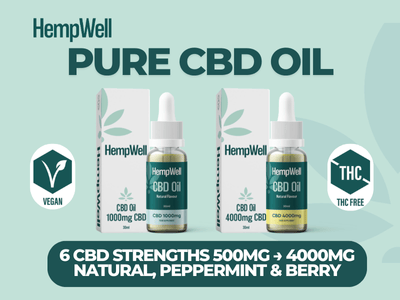
MCT oil is a clear, tasteless fat made from coconut oil, and it is the carrier in every bottle of our Pure CBD Oil. We use it for one practical reason: CBD dissolves in fat, and the research shows that taking CBD in or with fat delivers several times more of it into the body than taking it without. MCT oil does that job while adding no taste, no colour and a very long shelf life. This guide explains what MCT oil is, why it suits CBD, what the absorption research actually shows, and a sober look at the “MCT oil benefits” claims you will see elsewhere.
We make our oils at our laboratory in York Science Park, and the carrier oil is a deliberate choice rather than a filler. We cover where MCTs come from, the difference between our MCT-based isolate oils and our hemp seed oil broad spectrum range, how to take the oil to get the most from the carrier, and the honest limits of what a tablespoon of coconut fat can do for you.
Table of Contents
- What MCT oil is
- Why CBD needs a carrier oil
- The absorption evidence: fat makes the difference
- Why we chose MCT for Pure CBD Oil
- MCT oil vs hemp seed oil: our two carriers
- The “MCT oil benefits” claims, honestly
- How to take an MCT-based CBD oil
- How we do it at HempWell
- Frequently asked questions
What MCT oil is
MCT stands for medium-chain triglyceride. Fats are built from fatty-acid chains of different lengths; most of the fat in food is long-chain, while coconut oil and palm kernel oil are unusually rich in medium-chain fatty acids, mainly caprylic (C8) and capric (C10) acid. MCT oil is those medium-chain fats separated out from coconut oil and concentrated, which is why it is a thin, clear liquid at room temperature rather than the white solid that coconut oil becomes in an Irish kitchen. It is odourless, essentially tasteless, very stable, and widely used in food, cosmetics and pharmaceutical products as a carrier for fat-soluble ingredients.
Medium-chain fats are also handled differently by the body. They need less processing to be absorbed from the gut and are carried to the liver more directly than long-chain fats, where they are readily used for energy. That is the kernel of truth behind the energy and weight claims made for MCT oil, which we come back to below. For a CBD oil, what matters is simpler: it is a clean, neutral fat that CBD dissolves in completely.
Why CBD needs a carrier oil
CBD is a crystalline powder that does not dissolve in water but dissolves well in oil. Two things follow. A carrier oil is needed to turn a measured amount of CBD into a liquid you can dose with a graduated pipette: a 1000mg bottle is 1000mg of CBD dissolved in 30ml of oil, 33mg per millilitre. And the carrier changes how much CBD your body takes up, because fat is how CBD gets across the gut wall. A CBD product with no fat in it, such as a water-based drink or a dry capsule taken on an empty stomach, is at a real disadvantage. Our bioavailability guide explains the general principle; the next section gives the numbers.
The absorption evidence: fat makes the difference
The best-established fact in CBD pharmacology is that fat increases absorption, by a lot.
- In the safety and dosing trial of the prescription CBD solution, a high-fat meal “increased CBD plasma exposure (Cmax and AUCt) by 4.85- and 4.2-fold” compared with taking the same dose fasted (Taylor et al., 2018).
- In a study of pure CBD capsules in adults with epilepsy, the peak blood level was on average 14 times higher and total exposure 4 times higher after a high-fat breakfast than fasted (Birnbaum et al., 2019).
- Laboratory work on the mechanism found that oral co-administration of lipids “enhanced the systemic exposure of rats to THC and CBD by 2.5-fold and 3-fold, respectively, compared to lipid-free formulations”, and that cannabinoids have “high potential for intestinal lymphatic transport” when fats are present, a route that partly bypasses the liver (Zgair et al., 2016). The authors note the effect is expected in humans too.
- A systematic review of all the human pharmacokinetic data sums it up: peak levels are “increased during fed states and in lipid formulations” (Millar et al., 2018).
Two honest caveats. Those trials used prescription doses far above a food supplement, so the multiples are illustrative rather than a promise about your 33mg. And none of them compared MCT oil against other oils head to head; the finding is that fat in general helps, and MCT is a fat that is particularly easy to absorb. The strongest practical conclusion is the one we give every customer: take your CBD oil with or after food that contains some fat, whichever carrier it is in.
Why we chose MCT for Pure CBD Oil
- It is tasteless. CBD isolate has almost no taste, and MCT adds none, so the natural flavour of our Pure CBD Oil genuinely tastes of nearly nothing, which matters for people who hold it under the tongue every day or add it to a coffee.
- It is a liquid at room temperature and stays one in a cold house, unlike whole coconut oil, so the pipette works in January.
- It is stable. Medium-chain fats resist oxidation, which is part of why an unopened bottle keeps for a year or two (the best-before date is printed on the base of the bottle). Hemp seed oil, by contrast, is a delicate polyunsaturated oil that needs more care.
- It is well tolerated at the half-millilitre to millilitre amounts in a daily dose. Large amounts of MCT oil (tablespoons, as in the fitness world) can upset the stomach; a pipette of CBD oil does not get near that.
- It is plant-derived and vegan, from coconut.
MCT oil vs hemp seed oil: our two carriers
Our Broad Spectrum CBD Oil uses hemp seed oil instead. Hemp seed oil is pressed from the seeds of the plant, contains no cannabinoids itself, and has a green, nutty, earthy taste with a good omega-3 to omega-6 profile. We pair it with the broad spectrum extract because the fuller plant taste suits the fuller plant profile, and because customers who want broad spectrum tend to want the whole-plant character rather than neutrality. Both are fats, both do the carrier job; the choice is about taste and about which extract you want. Our guide to isolate vs broad spectrum sets out that decision, and our hemp oil benefits article covers hemp seed oil on its own terms, including why it is not the same thing as CBD oil.
| MCT oil (Pure CBD Oil) | Hemp seed oil (Broad Spectrum) | |
|---|---|---|
| Source | Coconut, medium-chain fats concentrated | Pressed hemp seeds |
| Taste | None | Nutty, earthy, green |
| Carries CBD | Yes | Yes |
| Stability | Very stable | Less stable; store cool and dark |
| Paired with | CBD isolate | THC-free broad spectrum extract |
| Vegan | Yes | Yes |
The “MCT oil benefits” claims, honestly
Search for MCT oil and you will find it credited with weight loss, heart health, energy, brain function and more. Some of that rests on real research into medium-chain fats taken in tablespoon amounts as part of a diet: there is evidence that MCTs are used for energy more readily than long-chain fats and modest evidence on satiety and weight in some trials. We make no such claims for our oils, for a simple reason: a full pipette of CBD oil contains about a millilitre of MCT, which is a fraction of a teaspoon. It is there to carry the CBD and to make the oil pleasant to take, not to change your metabolism. Anyone selling a CBD oil on the health benefits of its carrier is selling you the wrong thing.
How to take an MCT-based CBD oil
Measure with the graduated pipette rather than counting drops (a quarter pipette of the 1000mg oil is 8mg of CBD, a full pipette 33mg), hold it under the tongue for a minute, then swallow. Take it with or after a meal that contains some fat, at the same time each day, so that the amount you absorb is consistent. Most people start at 10 to 20mg a day and settle at 33mg, 50mg or 66mg, one full pipette of the 1000mg, 1500mg or 2000mg oils, within the 70mg a day guideline for healthy adults that we work to. Our how to take CBD oil guide covers technique and our dosage guide the amounts. MCT oil is also the carrier in SleepWell, our evening oil with valerian, passionflower and lavender.
How we do it at HempWell
Our CBD isolate is purified from hemp grown from EU-certified seed on our own farm in Europe, extracted with supercritical CO2 and purified to 99%+, then dissolved in organic MCT coconut oil and bottled by hand at our laboratory in York Science Park. Each product is independently lab tested, with the reports published on our lab reports page, and the range was developed with guidance from our Scientific Advisor, Professor Mike Barnes. More than 2,000 verified customers have reviewed it. All oils are on subscription at 20% off, and we deliver across Ireland with DPD, free over €50, same-day dispatch before 1pm.
Frequently asked questions
What is MCT oil made from?
Coconut oil, from which the medium-chain fats (mainly caprylic and capric acid) are separated and concentrated. Ours is organic and vegan.
Why is MCT oil used in CBD oil?
CBD dissolves in fat, and fat carries it across the gut wall; the trials show several times more CBD absorbed with fat than without. MCT is a neutral, stable, easily absorbed fat that does that job without adding any taste.
Is MCT oil better than hemp seed oil for CBD?
Both carry CBD well and nobody has shown one beats the other. MCT is tasteless and more stable; hemp seed oil has its own nutty flavour and suits the broad spectrum range. Choose by taste and by which extract you want.
Can MCT oil upset your stomach?
In tablespoon amounts, sometimes. A pipette of CBD oil contains about a millilitre, which is far below that. If you are sensitive, take it with food.
Does MCT oil contain CBD?
No. MCT oil on its own is just a fat. The CBD is added to it; the strength on the bottle tells you how much.
Is MCT oil safe for people with a coconut allergy?
Coconut allergy is rare but real. MCT oil is a refined fraction of coconut oil with the proteins largely removed, but if you have a diagnosed coconut allergy, choose our hemp seed oil-based Broad Spectrum range instead and speak to your doctor.