
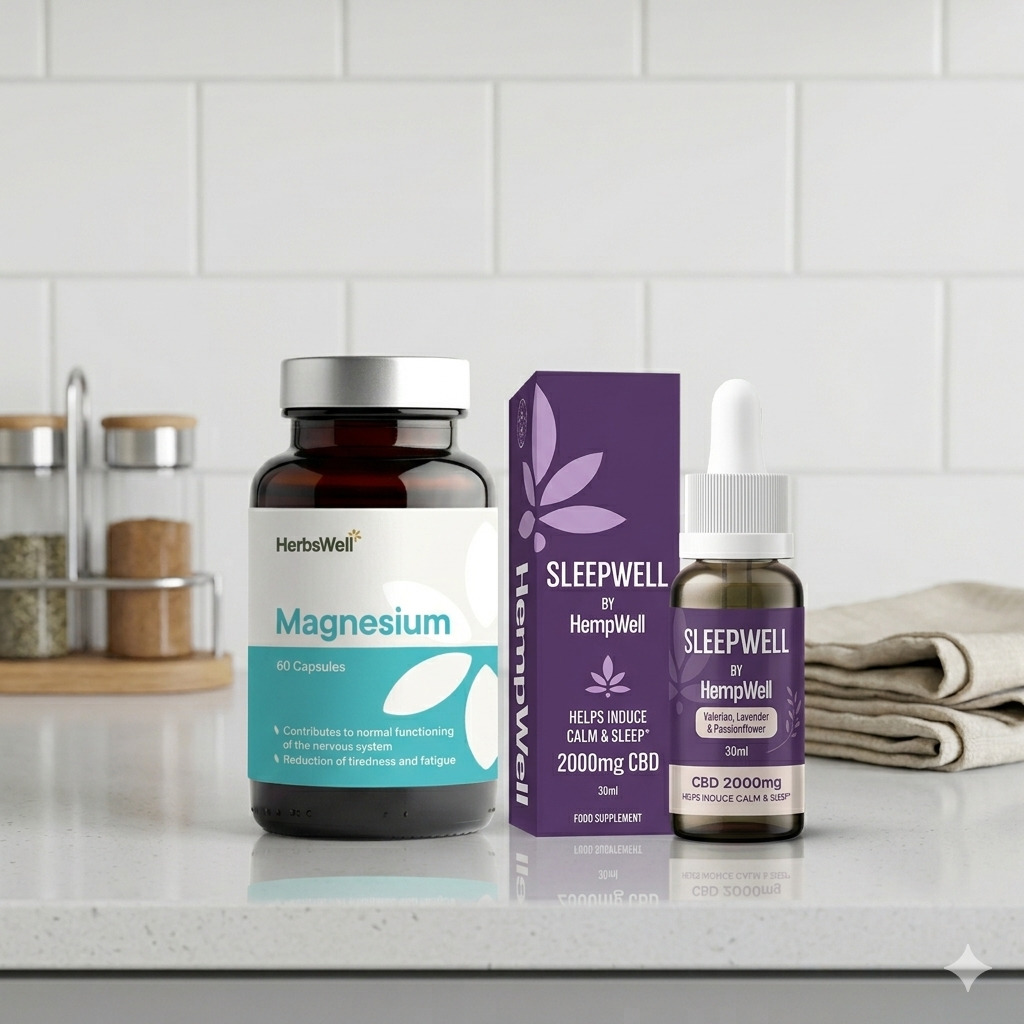
Irish adults average 6.9 hours of sleep on a weeknight according to the Healthy Ireland Survey 2025, and around a third get six hours or less. The natural sleep remedies with the best evidence are not products at all: a fixed wake time, a dark quiet room, no caffeine or alcohol late, and, for persistent insomnia, cognitive behavioural therapy for insomnia (CBT-i), which the HSE says helps most people who try it. Below that sit the supplements and herbs: valerian, chamomile, lavender, magnesium and CBD. Each has a place in a bedtime routine, none cures insomnia, and one popular option, melatonin, is prescription-only in Ireland and not legally sold in supplements here. This guide ranks what is actually available to you in Ireland by its evidence.
We cover the Irish picture, what the HSE advises first, each remedy’s evidence and Irish availability, how to build a routine that lets you judge a remedy fairly, and when to see a GP. We make SleepWell and our sleep range at our laboratory in York Science Park, and our scientific adviser is a consultant neurologist.
Table of Contents
- Ireland’s sleep in numbers
- What the HSE advises first
- Natural sleep remedies ranked by evidence
- Melatonin: why you cannot buy it in Ireland
- A two-week routine to test a remedy fairly
- Safety and when to see a GP
- How we do it at HempWell
- Frequently asked questions
Ireland’s sleep in numbers
The Department of Health’s Healthy Ireland Survey 2025, with more than 7,500 people aged 15 and over, found that people get 6.9 hours of sleep on an average weeknight, down from 7.1 hours in 2019, and that around a third of the population sleeps six hours or less (Healthy Ireland Survey 2025). That is a population problem, not a personal failing, and it is driven by the obvious things: later evenings, screens, shift patterns, worry, and a culture of late tea and coffee. The remedies that work address those causes; the ones that disappoint try to sedate past them.
What the HSE advises first
The HSE’s insomnia guidance is worth taking seriously because it is where the strong evidence sits: “go to bed and wake up at the same time every day”, “make sure your bedroom is dark and quiet”, “do not smoke or drink alcohol, tea or coffee less than 4 hours before bedtime”, and “do not watch television or use devices such as smartphones right before going to bed” (HSE, Insomnia). If sleep is still poor after a month, see your GP: “most people who try CBTi have better sleep”, and “GPs rarely prescribe medicine such as sleeping pills to treat insomnia”. The same page notes that pharmacy products with “natural ingredients such as valerian or lavender” exist but “cannot cure insomnia”. That is the frame for everything below.
Natural sleep remedies ranked by evidence
| Remedy | Evidence | Available in Ireland | Honest summary |
|---|---|---|---|
| CBT-i (sleep therapy) | Strong | Through your GP, online programmes | The treatment for persistent insomnia |
| Sleep hygiene and a fixed wake time | Strong | Free | The foundation every remedy sits on |
| Valerian | Mixed | Pharmacies and health shops; some HPRA-registered traditional herbal products | Safe, inconsistent results, worth a fair trial |
| Magnesium | Weak to modest | Widely available | May help if your intake is low; no effect expected otherwise |
| CBD | Early | Food supplement, THC-free only | Small gains in measured sleep efficiency; insomnia severity unchanged |
| Chamomile | Weak | Everywhere | A ritual more than a remedy |
| Lavender | Weak, mostly aromatherapy | Everywhere | Pleasant; a randomised trial found no sleep benefit |
| Melatonin | Good for jet lag and some circadian problems | Prescription only | Not a general sleeping pill; see below |
- Valerian. A 2020 review of 60 studies found results “inconsistent”, probably because of variable extract quality, no serious adverse events, and concluded “valerian could be a safe and effective herb to promote sleep” while calling for standardisation (Shinjyo et al., 2020).
- Magnesium. A systematic review of the randomised trials in older adults with insomnia found that magnesium shortened time to fall asleep by about 17 minutes on average, but rated the evidence low to very low quality (Mah and Pitre, 2021). It is cheap and safe at label amounts; a bisglycinate form is gentler on the stomach than oxide.
- CBD. The best recent trial gave 30 adults with insomnia 150mg of CBD or placebo nightly for two weeks: insomnia severity “did not differ between treatments”, but the CBD group “had superior objective sleep efficiency after 2 weeks” and reported greater well-being (Narayan et al., 2024). Our guide to CBD sleep drops covers how to use it and measure it.
- Chamomile. A small randomised trial of chamomile extract in chronic insomnia found “modest benefits of daytime functioning” and no significant sleep improvements (Zick et al., 2011). As a warm, caffeine-free drink that marks the end of the day it still earns its place.
- Lavender. A randomised hospital study found “no measurable advantages” for sleep over a placebo oil (Hamzeh et al., 2021). Pleasant scent, no proof.
Melatonin: why you cannot buy it in Ireland
Many Irish readers assume melatonin is sold over the counter as it is in the United States. It is not. The Food Safety Authority of Ireland’s position is that “in Ireland, melatonin is a prescription medication, is not authorised in food and should only be taken under medical supervision”, and it regularly recalls imported supplements that contain it (FSAI, October 2025). Melatonin is a timing signal rather than a sedative, so it suits jet lag and some body-clock problems, and your GP can prescribe it where appropriate. Buying it online from abroad risks the wrong dose, the wrong timing and a customs seizure.
A two-week routine to test a remedy fairly
- Fix the wake time first, seven days a week, and get daylight soon after. This is the single most powerful change.
- Cut caffeine after lunch and alcohol in the evening for the whole two weeks. Alcohol makes you drowsy and then fragments the second half of the night.
- Build a 30-minute wind-down with no screens: shower, book, stretch, a chamomile tea.
- Add one remedy only, at the same time each night: a quarter pipette of SleepWell CBD Oil (about 17mg of CBD, measured with the graduated pipette, 30 to 60 minutes before bed), or a magnesium bisglycinate capsule (150mg elemental) with your evening meal, or a valerian product from the pharmacy at the label amount.
- Score each morning out of ten on how rested you feel, not how fast you fell asleep. Judge at two weeks.
- If nothing moves, see your GP and ask about CBT-i rather than adding a second product.
Our CBD for sleep collection has the formats side by side, and our CBD and Sleep Starter Pack (€39.99) lets you try a small bottle before committing.
Safety and when to see a GP
- Snoring, gasping or waking unrefreshed every day can be sleep apnoea, which needs a GP, not a remedy.
- Low mood, anxiety or pain driving the sleeplessness need treating in their own right.
- Medicines. Valerian and CBD both add to sedation with sleeping tablets or alcohol, and CBD shares liver pathways with some medicines; see our guide to CBD and medication interactions. Magnesium can interact with some antibiotics; take them hours apart.
- Not for under-18s, pregnancy or breastfeeding without medical advice, for any of these supplements.
- THC-free only. Any THC in a CBD product makes it a controlled drug in Ireland; our legal guide explains.
How we do it at HempWell
- Honest about the evidence. We quote the HSE’s “cannot cure insomnia” line because it is true of our products too.
- Measured servings. SleepWell is 67mg of CBD per ml with a graduated pipette; our Sleep Support tablets are a fixed 10mg; our magnesium is 150mg elemental per capsule. You always know what you took.
- Legal in Ireland. THC-free CBD isolate with lab reports on our lab reports page, delivered by DPD, free over €50.
- Medical oversight. Our health content is written with Professor Mike Barnes, a consultant neurologist, as our scientific adviser.
Frequently asked questions
What is the best natural sleep remedy in Ireland?
A fixed wake time and the HSE’s sleep-hygiene list, then CBT-i through your GP if insomnia persists. Among supplements, valerian has the longest record, magnesium may help if your intake is low, and CBD has one small positive trial.
Can I buy melatonin in Ireland?
Only on prescription. It is not permitted in food supplements sold in Ireland, and the FSAI recalls imported products that contain it.
Does magnesium help you sleep?
The trials are small and low quality, with a modest effect on time to fall asleep. It is safe at label amounts and most useful if your diet is short of it.
Does CBD help you sleep?
One modern trial found small gains in measured sleep efficiency and well-being over two weeks, with no change in insomnia severity. Well tolerated, not habit-forming, not a cure.
Is valerian safe to take every night?
Reviews report no serious adverse events, but take it at the label amount, not with alcohol or sleeping tablets, and tell your pharmacist if you take other medicines.
When should I see a GP about sleep?
If poor sleep has lasted more than a month despite the basics, if you snore heavily or stop breathing at night, or if low mood, anxiety or pain is behind it.