
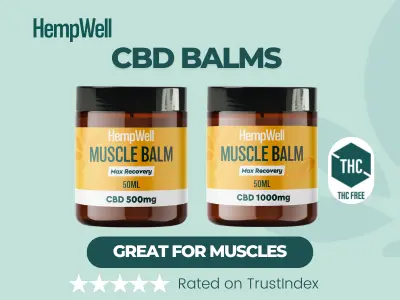
A CBD balm is used like any muscle rub: a pea-sized amount warmed between the fingers and massaged into clean, dry skin over the sore muscle or joint, two or three times a day. The CBD, menthol and eucalyptus act in the skin and tissue where you put them. They do not travel through the skin into the bloodstream in any meaningful amount, which is why a balm is the right format for a stiff shoulder and the wrong one for anything that needs CBD inside you. This guide covers technique, how much to use, which strength, where a balm beats a cream and where a cream beats a balm, and what the evidence for topical CBD actually looks like.
We make our balms by hand at our laboratory in York Science Park in a soya wax and cocoa butter base, in 500mg and 1000mg strengths, and they are sold in Ireland as cosmetics, not medicines. We would rather tell you honestly what a balm can and cannot do than sell you one for the wrong job.
Table of Contents
- How to apply CBD balm, step by step
- How much to use and how often
- 500mg or 1000mg: which strength
- Balm, cream or roll-on: which to pick
- How a CBD balm works, and the evidence
- A balm is not the answer for nerve pain
- Skin, safety and who should not use it
- How we do it at HempWell
- Frequently asked questions
How to apply CBD balm, step by step
- Start with clean, dry skin. Wash off sweat, lotion or sun cream, which sit between the balm and the skin and dilute it. After a shower or a warm bath is ideal, because warm skin takes a balm more readily.
- Take a pea-sized amount. Scoop a small amount on a fingertip and warm it for a few seconds between your fingers so it softens; a wax-based balm goes further and spreads more evenly when it is warm.
- Massage it in. Work it into the muscle or around the joint with firm circular pressure for a minute or two. The massage is part of the effect, not just a way of applying the product: it warms the tissue and loosens a tight muscle before the menthol has done anything.
- Let it absorb. Give it ten to fifteen minutes before covering the area with tight clothing or a support. The cooling from the menthol and eucalyptus is felt within minutes; the balm itself is largely absorbed in half an hour.
- Wash your hands, and keep it away from eyes, lips and broken skin. Menthol stings on any of them.
For a large area such as the lower back or a thigh, use two pea-sized amounts rather than one big one; for a knuckle or a tendon, a dab is enough. Our guide on how to use CBD cream covers the same technique for the cream format.
How much to use and how often
Two or three applications a day is the normal pattern, for example morning, after exercise and before bed, and there is no benefit in piling it on. A 50ml jar used that way on one area lasts about a month. Because a balm acts locally, the daily CBD ceiling we work to for food supplements (70mg) does not apply to it; what you can feel on the skin is the limit. If you are using a balm alongside an oil or capsules, the two do not add up, because the balm’s CBD is not reaching your bloodstream.
500mg or 1000mg: which strength
Both jars are 50ml, so the 500mg balm is 10mg of CBD per millilitre and the 1000mg balm is 20mg per millilitre. The base, the menthol and the eucalyptus are the same, so the cooling sensation is identical; only the CBD concentration doubles. A pea-sized amount is roughly half a millilitre, so one application delivers about 5mg of CBD to the skin from the 500mg jar and about 10mg from the 1000mg.
Our suggestion is the 500mg for everyday use on a niggle or after sport, and the 1000mg for an area you are treating regularly, such as a knee or a lower back that bothers you most days. Nobody needs to start at the top. If you want more CBD on the skin than the 1000mg balm gives, the answer is not a stronger balm but our 2000mg Cooling Muscle and Joint Cream, which is the strongest topical we make and the best-selling product in the range. Our guide to topical strengths goes through the maths.
Balm, cream or roll-on: which to pick
| Muscle balm | Cooling cream | Roll-on | |
|---|---|---|---|
| Base | Soya wax and cocoa butter, solid in the jar | Water-based cream with grapeseed oil and vitamin E | Liquid gel in a rollerball |
| Feel | Rich, slow to absorb, leaves a protective layer | Light, absorbs fast, no residue | Cooling, no hands needed |
| Best for | Massage into a specific muscle or joint; dry skin; hands, knees, feet | Large areas (back, legs), quick application, under clothing | On the go, neck and shoulders, mess-free |
| Strengths | 500mg / 1000mg in 50ml | 500 / 1000 / 2000mg in 100ml | See the roll-on collection |
| Travels further | Yes: a little balm covers more skin than the same amount of cream | No, but easier to spread thinly | Compact |
If you are still unsure, our cream vs balm chooser was written for exactly this decision, and the full range is in the balms and creams collections.
How a CBD balm works, and the evidence
Three things happen when you rub in a CBD balm. The massage warms and loosens the muscle. The menthol and eucalyptus trigger the skin’s cold-sensing nerves, producing the cooling that distracts from an ache in the way an ice pack does, without the ice. And the CBD stays in the skin and the tissue just beneath it. That last point is the one to be clear about: topicals act locally. The skin is a barrier, and an ordinary balm or cream does not deliver CBD into the bloodstream in meaningful amounts. Patches are the transdermal exception, designed to push a steady amount through the skin over 24 hours. Our guide to topical vs transdermal CBD explains the distinction properly.
What does the research say about CBD on the skin? Less than the marketing suggests, and we would rather say so. The animal data are encouraging: a transdermal CBD gel applied to rats with an inflamed knee “significantly reduced joint swelling” and pain-related behaviour “in a dose-dependent manner” (Hammell et al., 2016). In humans there is one small randomised trial, of 29 people with nerve pain in the feet and legs, which found “a statistically significant reduction in intense pain, sharp pain, cold and itchy sensations in the CBD group” after four weeks of a 250mg CBD oil applied to the skin, with no adverse events (Xu et al., 2020). That is a reason for interest, not a claim. There is no trial of a CBD balm on sore muscles or arthritic joints, so what we can honestly say is that the massage and the cooling are well understood, and the CBD is the part people come back for. Our arthritis guide and pain hub set out the wider evidence.
A balm is not the answer for nerve pain
If your pain is shooting, burning or tingling rather than a muscular ache, a balm on the skin is unlikely to reach it, because nerve pain is generated deeper and often somewhere other than where it is felt. Sciatica is the common example: the problem is in the lower back, the pain is in the leg. A cooling balm or cream can still be a comfort on a tight back or hip, but it is not treating the nerve, and the honest evidence on CBD for nerve pain generally is thin. Our guides on CBD and nerve pain and which CBD format for which pain go through it. For pain that is new, severe or not improving after a few weeks of self-care, see your GP; a balm is for comfort, not diagnosis.
Skin, safety and who should not use it
Try a small amount on the inside of a forearm the first time and wait a few hours, as you would with any new skincare product; menthol and essential oils can irritate sensitive skin. Do not apply to broken skin, rashes, eczema flares or near the eyes, and do not use under a heat pad or heated wrap, which intensifies menthol unpleasantly. Because the balm does not enter the bloodstream, it does not interact with medicines the way an oil can, and it is not a concern for workplace drug tests (it is THC-free in any case, as our drug test guide explains). We do not recommend any of our products during pregnancy or breastfeeding, or for anyone under 18, simply because they have not been studied in those groups. Our balms are vegan.
How we do it at HempWell
Our balms are made by hand at our laboratory in York Science Park from CBD isolate purified from hemp grown on our own farm in Europe, in a base of soya wax and cocoa seed butter with eucalyptus, cajeput and mint essential oils. Each product is independently lab tested, with the reports published on our lab reports page, and the topical range was developed with guidance from our Scientific Advisor, Professor Mike Barnes. More than 2,000 verified customers have reviewed our products. Balms are on subscription at 20% off, and we deliver across Ireland with DPD, free over €50, same-day dispatch before 1pm.
Frequently asked questions
How often can I apply CBD balm?
Two or three times a day on the same area is the usual pattern. There is no daily limit in the way there is for an oil, because the balm acts in the skin, but more than three applications a day is wasteful rather than helpful.
How long does CBD balm take to work?
The cooling from the menthol and eucalyptus is felt within a few minutes and lasts an hour or two. Any effect from the CBD in the tissue builds with regular use over days rather than minutes.
Does CBD balm get into your bloodstream?
Not in meaningful amounts. Topicals act locally; only patches are designed to pass CBD through the skin. That is why a balm will not show on a drug test and does not count towards a daily CBD amount.
Can I use CBD balm with CBD oil?
Yes, and many people do: the oil for the inside, the balm for the spot. They do not add up, because the balm’s CBD stays in the skin.
Which is better for arthritis, balm or cream?
Neither is a treatment for arthritis. For hands and small joints, a balm you can massage in is often preferred; for a knee or hip, the cream spreads more easily and is available in 2000mg. Our arthritis guide covers the evidence honestly.
Is CBD balm legal in Ireland?
Yes. It is sold as a cosmetic, it contains no THC, and it is applied to the skin. Our guide to CBD law in Ireland explains the position for each product type.