

No, CBD does not get you high. Cannabidiol is one of the main compounds in the hemp plant, but it is not the one that causes a high: that is THC, a different compound that is a controlled drug in Ireland and is not present in a properly made CBD product. The World Health Organization’s expert review found CBD “was not found to have psychoactive properties” and “presents no potential for abuse or dependence”, and controlled trials in which healthy adults took CBD and were then tested on driving and thinking tasks found no impairment.
That is the short answer. This guide covers the longer one: what people actually report feeling after CBD oil, gummies or a vape, why “psychoactive” and “intoxicating” are not the same thing, the situations in which a product sold as CBD could make you feel high (and what that tells you about the product), and what the research says about driving and drug tests. We make our own CBD at our laboratory in York Science Park, so we have added what we see from our own lab reports and customers too.
Table of Contents
- Does CBD get you high? The short answer
- CBD and THC: same plant, very different effects
- “Psychoactive” is not the same as “intoxicating”
- What CBD actually feels like, according to the trials
- Does it matter if it is oil, gummies or a vape?
- When a “CBD” product can get you high, and why that is a red flag in Ireland
- Driving and drug tests
- How we do it at HempWell
- Frequently asked questions
Does CBD get you high? The short answer
CBD is not intoxicating. It does not produce the euphoria, altered perception, giggles, red eyes or impaired coordination that people associate with cannabis, because all of those come from THC (tetrahydrocannabinol) acting on the brain’s CB1 receptors. CBD barely activates those receptors at all. In 2018 the World Health Organization’s Expert Committee on Drug Dependence reviewed the evidence and recommended that “preparations considered to be pure cannabidiol (CBD) not be placed under international drug control”, because “the substance was not found to have psychoactive properties” and “presents no potential for abuse or dependence” (WHO, 40th ECDD briefing, September 2018).
Irish law reflects the same science. CBD itself is not controlled under the Misuse of Drugs Acts; THC is, at any level in a finished product. Our guide to whether CBD is legal in Ireland covers the detail, but the practical point for this question is simple: a CBD product that is legal to sell in Ireland contains no THC, and without THC there is nothing in it that can get you high.
CBD and THC: same plant, very different effects
Hemp and cannabis are the same species, Cannabis sativa, grown for different purposes. Both produce a family of compounds called cannabinoids, and the two best known are CBD and THC. They are chemically similar, which is why people assume they do similar things, but they interact with the body in almost opposite ways. THC fits into the CB1 receptor in the brain like a key and switches it on; that activation is the high. CBD does not switch CB1 on. If anything, it dampens the receptor’s response and works through other targets instead, including serotonin receptors and the enzyme that breaks down the body’s own cannabinoids. Our explainer on the endocannabinoid system goes into how that works.
| THC | CBD | |
|---|---|---|
| Gets you high? | Yes: euphoria, altered perception, impaired coordination | No |
| How it acts | Activates CB1 receptors in the brain | Does not activate CB1; acts on other targets |
| Abuse or dependence potential (WHO) | Yes, controlled internationally | “No potential for abuse or dependence” |
| Status in Ireland | Controlled drug at any level in a product | Not a controlled drug; sold as a food supplement |
| Driving (JAMA trial, 2020) | Measurable lane-weaving for 1 to 2 hours | No difference from placebo |
| Shows on a cannabis drug test? | Yes | No (pure CBD, Johns Hopkins 2020) |
“Psychoactive” is not the same as “intoxicating”
You will see CBD described as “non-psychoactive” and, elsewhere, as “psychoactive but non-intoxicating”, and both camps have a point. Strictly, psychoactive means anything that affects mood or mental state, and by that definition caffeine, chocolate and a warm bath qualify. CBD is being studied precisely because it may have gentle effects on how people feel, so some researchers prefer “non-intoxicating”. What matters to the question in the title is intoxication: whether a substance distorts your perception, judgement and coordination. CBD does not. The WHO’s wording, “not found to have psychoactive properties”, is the regulators’ way of saying it produces no THC-like effects, and that is the sense most people mean when they ask.
What CBD actually feels like, according to the trials
The most useful evidence comes from controlled studies where people took CBD without knowing whether they had the real thing or a placebo, then rated how they felt and performed tests.
- Oral CBD felt like nothing. At Johns Hopkins, 18 healthy adults who rarely used cannabis took 100mg of CBD by mouth, 100mg vaporised, vaporised CBD-dominant cannabis (100mg CBD with 3.7mg THC) or placebo in separate sessions. The researchers reported that “subjective effects of oral CBD did not differ from placebo” and that “cognitive/psychomotor impairment was not observed in any drug condition” (Spindle et al., 2020).
- Inhaled CBD was noticeable but not impairing. In the same study, vaporised CBD did produce effects people could detect, such as a higher “like drug effect” rating, but “CBD did not increase ratings for several items typically associated with acute cannabis/THC exposure (e.g., Paranoid)”, and performance on cognitive and motor tests was unaffected.
- Higher doses were well tolerated. A separate placebo-controlled study of 200mg, 400mg and 800mg of oral CBD in healthy volunteers found “oral CBD was safe and well tolerated, producing small decreases in blood pressure”, with only modest, dose-related effects on mood ratings (Babalonis et al., 2022). Those amounts are many times what anyone takes as a food supplement; the Food Safety Authority of Ireland’s guidance for healthy adults is to stay under 70mg a day.
Put together, that matches what our customers tell us. People taking CBD oil or capsules at normal food-supplement amounts describe feeling no different in the moment, or at most a little calmer or more settled over days and weeks. Nobody describes a high, and if someone did, we would want to see the product. If you are new to it and wondering when to expect anything, our guide to how long CBD takes to work sets realistic expectations.
Does it matter if it is oil, gummies or a vape?
The format changes how quickly CBD is absorbed, not whether it can get you high. CBD gummies and capsules are swallowed, so the CBD passes through the digestive system and the liver and reaches the bloodstream slowly, which is why the oral group in the Johns Hopkins study felt nothing at all. CBD oil held under the tongue for a minute is absorbed a little faster. A CBD vape delivers CBD to the bloodstream within minutes, which is why the vaporised group could tell they had taken something, but even then the trial recorded no impairment and none of the paranoia or perception changes that mark a THC high. Whatever the format, the rule is the same: if there is no THC in it, it cannot get you high.
The “body high” people describe online after CBD is usually one of three things: the relaxation of taking a moment to do something for yourself, the placebo effect, or a product that was not what it said on the label. Which brings us to the real risk.
When a “CBD” product can get you high, and why that is a red flag in Ireland
If a product sold as CBD does make you feel high, it contains THC. That happens in three ways. “Full-spectrum” products deliberately keep a small amount of THC from the plant; those are legal in some countries but not in Ireland, where any THC in a finished product makes it a controlled drug. Poorly made products can contain far more THC than the label says; the FSAI’s own survey of CBD products on the Irish market found THC in 84% of those tested, and 37% at levels that could exceed the European Food Safety Authority’s safe daily limit if taken as directed (FSAI survey of hemp-based foods and supplements). And some products marketed with cannabis imagery contain other intoxicating cannabinoids altogether, such as HHC, which have nothing to do with CBD.
So the question to ask of any CBD product in Ireland is not “will it get me high” but “where is the lab report showing THC was not detected”. For a CBD isolate product that should be a given; for a broad-spectrum product, which keeps the plant’s other non-intoxicating cannabinoids, the THC must have been removed and the report should say so. Our guide to isolate versus broad-spectrum CBD explains the difference, and every HempWell report is on our lab reports page.
Driving and drug tests
Because CBD is not intoxicating, the two worries that follow from “does it get you high” mostly fall away, and the research is unusually direct on both.
Driving. In a randomised trial published in JAMA, 26 healthy adults drove 100km on a public motorway after vaporising THC-dominant cannabis, CBD-dominant cannabis, a mix, or placebo. THC increased lane weaving for the first couple of hours, roughly the effect of a blood alcohol level just over the Irish drink-drive limit for experienced drivers. CBD-dominant cannabis did not: “there were no significant differences between CBD-dominant cannabis and placebo” (Arkell et al., JAMA, 2020). In Ireland the driving offence that matters is THC in the blood under the Road Traffic Act, which is another reason to use a THC-free product; our guide to driving on CBD oil in Ireland covers it.
Drug tests. Workplace and roadside tests look for THC and its breakdown products, not CBD. In the Johns Hopkins urine study, after pure CBD “only 1 out of 218 urine specimens screened positive” at the most sensitive cut-off and none confirmed positive, leading the authors to conclude that “acute dosing of pure CBD will not result in a positive urine drug test”. After CBD-dominant cannabis containing 3.7mg of THC, however, several samples did confirm positive (Spindle et al., Journal of Analytical Toxicology, 2020). A 2022 follow-up found “no evidence of CBD conversion to Δ8- or Δ9-THC” in the body after pure CBD (Sholler et al., 2022). The lesson is the same as above: THC-free CBD will not fail you a test, and a product with “a little” THC might. See our guide to CBD and workplace drug tests in Ireland for the practical side.
How we do it at HempWell
We have made CBD since 2017, and the way we make it is the answer to the question in the title.
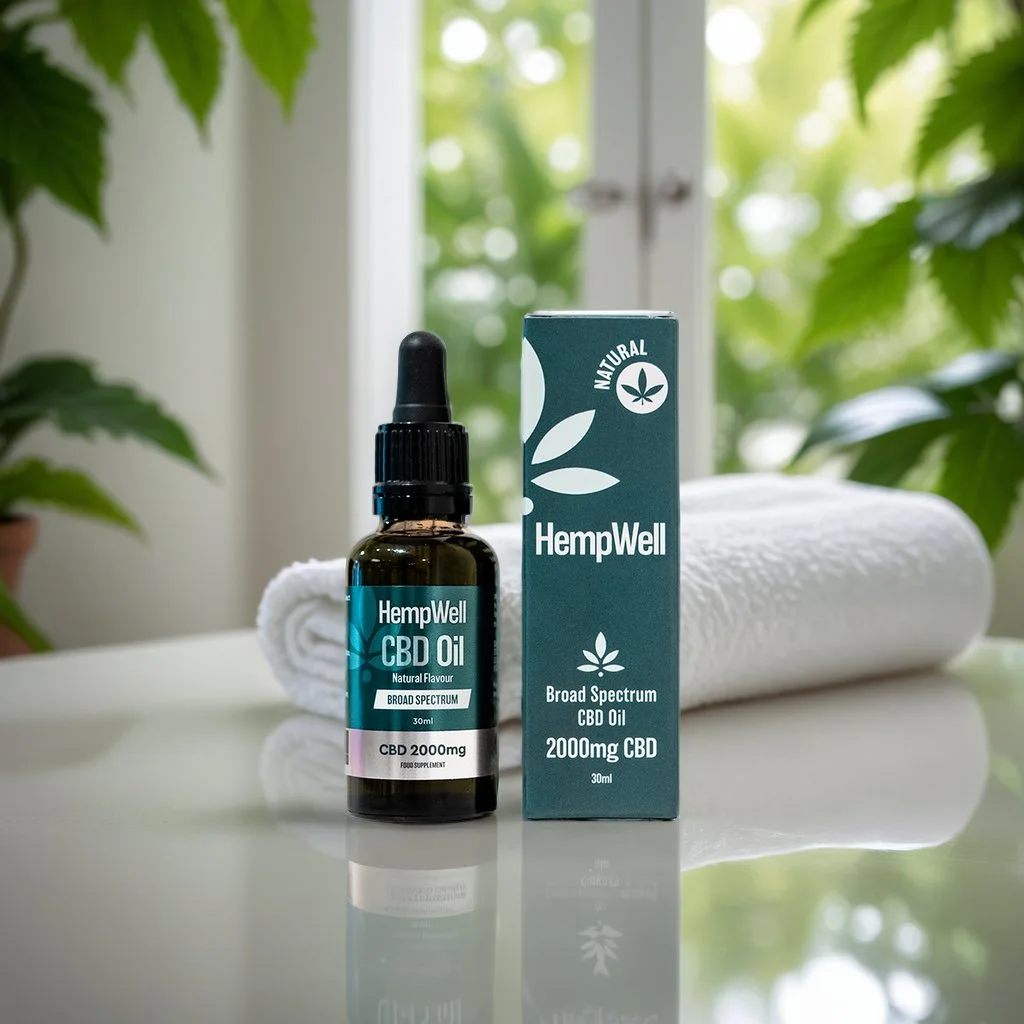
- No THC, by design. Our Pure CBD Oil range is CBD isolate, which is CBD and nothing else from the plant, in organic MCT oil. Our Broad Spectrum range keeps the plant’s other non-intoxicating cannabinoids with the THC removed. Gummies, capsules and vapes follow the same rule.
- Proven on paper. Each product is independently lab tested and the certificate of analysis, including the THC line, is published on our lab reports page. Look for the batch number on your bottle and read the report before you take it.
- Our own supply chain. Hemp from our own EU farm, extracted and bottled at our laboratory in York Science Park, delivered across Ireland with DPD, free on orders over €50.
- Honest about effects. CBD is a food supplement. We do not promise it will make you feel any particular way, and we do not sell anything that will get you high. Our scientific adviser, Professor Mike Barnes, a consultant neurologist, keeps us honest on the science.
If you are starting out, our CBD dosage guide explains how to begin low and build up, and our guide to CBD safety covers side effects and who should check with a doctor first.
Frequently asked questions
Does CBD oil get you high?
No. CBD oil made from CBD isolate or THC-removed broad-spectrum extract contains no THC, so there is nothing in it that can produce a high. In controlled trials, oral CBD was indistinguishable from placebo on how people felt.
Do CBD gummies get you high?
No. Gummies deliver CBD slowly through digestion, and CBD is not intoxicating in any format. If a gummy sold as CBD makes you feel high, it contains THC or another intoxicating cannabinoid and should not be on sale in Ireland.
Does vaping CBD get you high?
No. Inhaled CBD reaches the bloodstream faster, and in trials people could tell they had taken something, but there was no impairment, paranoia or altered perception. A THC-free CBD vape cannot get you high.
What does CBD feel like?
For most people at food-supplement amounts, nothing noticeable in the moment. Over days or weeks some describe feeling calmer or more settled. It does not feel like cannabis.
Is CBD psychoactive?
It depends on the definition. CBD may have gentle effects on mood, which some scientists call psychoactive, but it is not intoxicating: the WHO found it “was not found to have psychoactive properties” in the sense of THC-like effects.
Can you get high from a lot of CBD?
No. Studies giving healthy adults up to 800mg at once, many times a normal daily amount, reported it was well tolerated with no intoxication. Large amounts are more likely to cause tiredness or a dry mouth than anything else, and the FSAI advises healthy adults to stay under 70mg a day.