
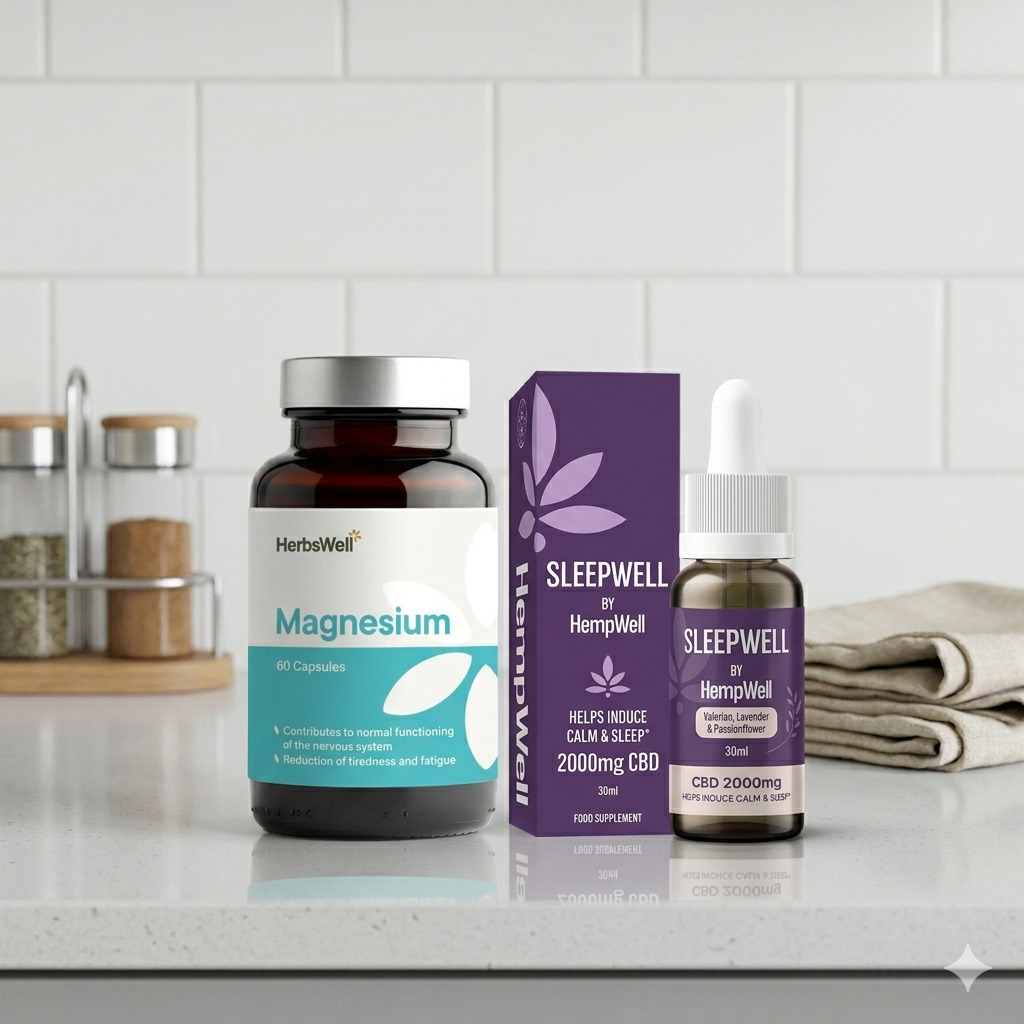
CBD sleep drops are a CBD oil taken in the evening, usually blended with herbs long associated with rest such as valerian and lavender. They are a food supplement, not a sleep medicine, and the honest summary of the research is that CBD at the amounts people take at bedtime has not been shown to cure insomnia, but is well tolerated, is not habit-forming, and in the one modern placebo-controlled trial produced small improvements in measured sleep efficiency and well-being without changing insomnia severity. That makes them a reasonable part of a bedtime routine for someone sleeping badly, and a poor substitute for fixing the routine itself. This guide covers both.
We explain what is in sleep drops and what each ingredient’s evidence looks like, what the HSE advises for poor sleep (which is where to start), how to use sleep drops so you can judge them fairly, safety, and how our own SleepWell oil is made. We make it at our laboratory in York Science Park, and our scientific adviser is a consultant neurologist.
Table of Contents
- What CBD sleep drops are
- Poor sleep: what the HSE advises first
- The evidence, ingredient by ingredient
- How to use sleep drops so you can judge them
- Drops, tablets, tea or patches?
- Safety and who should not use them
- How we make SleepWell at HempWell
- Frequently asked questions
What CBD sleep drops are
A sleep drops product is a CBD oil, measured out with a graduated pipette and held under the tongue, with ingredients chosen for the evening. Ours, SleepWell CBD Oil, is 2000mg of THC-free CBD in a 30ml bottle (67mg per ml, about 17mg in a quarter pipette) with lavender and valerian. The CBD is the same compound as in any CBD oil; our explainer on what CBD is covers it. The herbs are there because they have a long history in evening remedies, and because they make the oil smell and taste like bedtime, which matters more to a routine than people admit.
Poor sleep: what the HSE advises first
Before any supplement, the HSE’s insomnia guidance is worth taking seriously, because it is where the strong evidence sits: “go to bed and wake up at the same time every day”, “make sure your bedroom is dark and quiet”, “do not smoke or drink alcohol, tea or coffee less than 4 hours before bedtime”, and “do not watch television or use devices such as smartphones right before going to bed” (HSE, Insomnia). If sleep is still poor after a month of that, see your GP: “most people who try CBTi have better sleep”, and “GPs rarely prescribe medicine such as sleeping pills to treat insomnia”. On supplements, the HSE notes that pharmacy products with “natural ingredients such as valerian or lavender” exist but “cannot cure insomnia”. We agree, and we would add CBD to that sentence.
The evidence, ingredient by ingredient
- CBD. The relevant trial gave 30 adults with moderate to severe insomnia 150mg of CBD or placebo under the tongue an hour before bed for two weeks, with wrist actigraphy. Insomnia severity, time to fall asleep and time awake in the night “did not differ between treatments”, but the CBD group “reported greater well-being scores throughout the trial” and “had superior objective sleep efficiency after 2 weeks of treatment” (Narayan et al., Journal of Clinical Sleep Medicine, 2024). Small, short, and at double the FSAI’s daily guidance, but the honest headline is “not a cure, possibly a modest help, well tolerated”. Daytime sleepiness is among the more consistent CBD side effects at higher doses (Taylor et al., 2018), which is one reason evening use makes sense.
- Valerian. A 2020 systematic review of 60 studies found results were “inconsistent”, likely because of variable extract quality, with no serious adverse events across ages 7 to 80, and concluded “valerian could be a safe and effective herb to promote sleep” while calling for better standardisation (Shinjyo et al., 2020). Mixed evidence, good safety.
- Lavender. Evidence for lavender and sleep is mostly from aromatherapy studies of varying quality; a randomised hospital study found “no measurable advantages” for sleep against a placebo oil (Hamzeh et al., 2021). In a sleep oil it is a scent and a ritual rather than a drug, and we present it that way.
- What CBD is not. It is not a sedative in the way a sleeping tablet is, it does not cause dependence, and it does not get you high; our guides on whether CBD gets you high and CBD oil side effects cover the research.
How to use sleep drops so you can judge them
- Measure with the pipette, not by drops. Our pipettes are graduated. Start with a quarter pipette of SleepWell (about 17mg of CBD) and hold it under the tongue for a minute before swallowing.
- Same time every night, 30 to 60 minutes before bed, as part of a wind-down that also follows the HSE list above.
- Give it two weeks before deciding, and judge it on how you feel in the morning rather than how fast you fell asleep.
- Adjust slowly, staying within the Food Safety Authority of Ireland’s 70mg-a-day guidance for healthy adults; a full pipette is 67mg. Our CBD dosage guide explains the steps.
- Do not stack it with alcohol or sleeping tablets, and do not drive after an evening dose until you know your response.
Drops, tablets, tea or patches?
| Format | CBD per serving | Suits | Price in Ireland |
|---|---|---|---|
| SleepWell CBD Oil 2000mg | 17mg per quarter pipette (67mg per ml) | Adjustable amounts, fastest to take effect | €69.99 |
| Sleep Support CBD Tablets | 10mg per tablet | A fixed, gentle amount, no taste | €19.99 for 30 |
| Chamomile CBD Tea | About 3mg per bag | The ritual more than the dose | €12.99 for 12 |
| CBD Patches 30mg | 30mg over 24 hours | Steady, slow delivery for people who dislike oil | €29.99 for 30 |
| CBD and Sleep Starter Pack | Mixed | Trying the formats before committing | €39.99 |
Our page on CBD and sleep brings the range and the research together.
Safety and who should not use them
- Medicines. Sleeping tablets, sedatives, anti-epileptics and anticoagulants are the groups to check first; valerian adds to sedation. See our guide to CBD and medication interactions.
- Not for under-18s, pregnancy, breastfeeding or anyone trying to conceive, per the regulators’ precautionary advice.
- Morning grogginess at higher amounts: reduce the dose or take it earlier.
- Snoring, gasping or daytime exhaustion despite sleep can be sleep apnoea, which needs a GP, not a supplement.
- THC-free only. Any THC in a product is a controlled drug in Ireland; our legal guide explains, and our lab reports show the THC line for each product.
How we make SleepWell at HempWell
- Our own CBD. CBD isolate, so CBD and nothing else from the plant, made from hemp grown on our own EU farm and blended with lavender and valerian at our laboratory in York Science Park, independently lab tested.
- Measured, not guessed. 67mg of CBD per ml with a graduated pipette, so a quarter, half or full pipette is a known amount.
- No cure claims. SleepWell is a food supplement for an evening routine. The HSE’s advice and, if needed, your GP’s, come first.
- Medical oversight. Our health content is written with Professor Mike Barnes, a consultant neurologist, as our scientific adviser.
Browse the CBD for sleep collection, delivered across Ireland by DPD and free on orders over €50.
Frequently asked questions
Do CBD sleep drops work?
They have not been shown to cure insomnia. The one modern placebo-controlled trial found no change in insomnia severity but small improvements in measured sleep efficiency and well-being over two weeks, with CBD well tolerated. Many people find them a useful part of a wind-down routine.
How much SleepWell should I take?
Start with a quarter pipette (about 17mg) 30 to 60 minutes before bed, measured with the graduated pipette, and adjust slowly within the FSAI’s 70mg-a-day guidance.
Are CBD sleep drops addictive?
No. The WHO found CBD has no potential for abuse or dependence, and valerian has a long safety record. Stopping them does not cause withdrawal.
Can I take CBD sleep drops with sleeping tablets?
Not without asking your GP or pharmacist. Both cause drowsiness, and some sleeping tablets share CBD’s metabolic pathways.
Will I feel groggy in the morning?
Some people do at higher amounts. Reduce the amount or take it earlier in the evening, and never drive until you know how you respond.
Are CBD sleep drops legal in Ireland?
THC-free ones are, as food supplements. Any THC makes a product a controlled drug here, so check the lab report.