
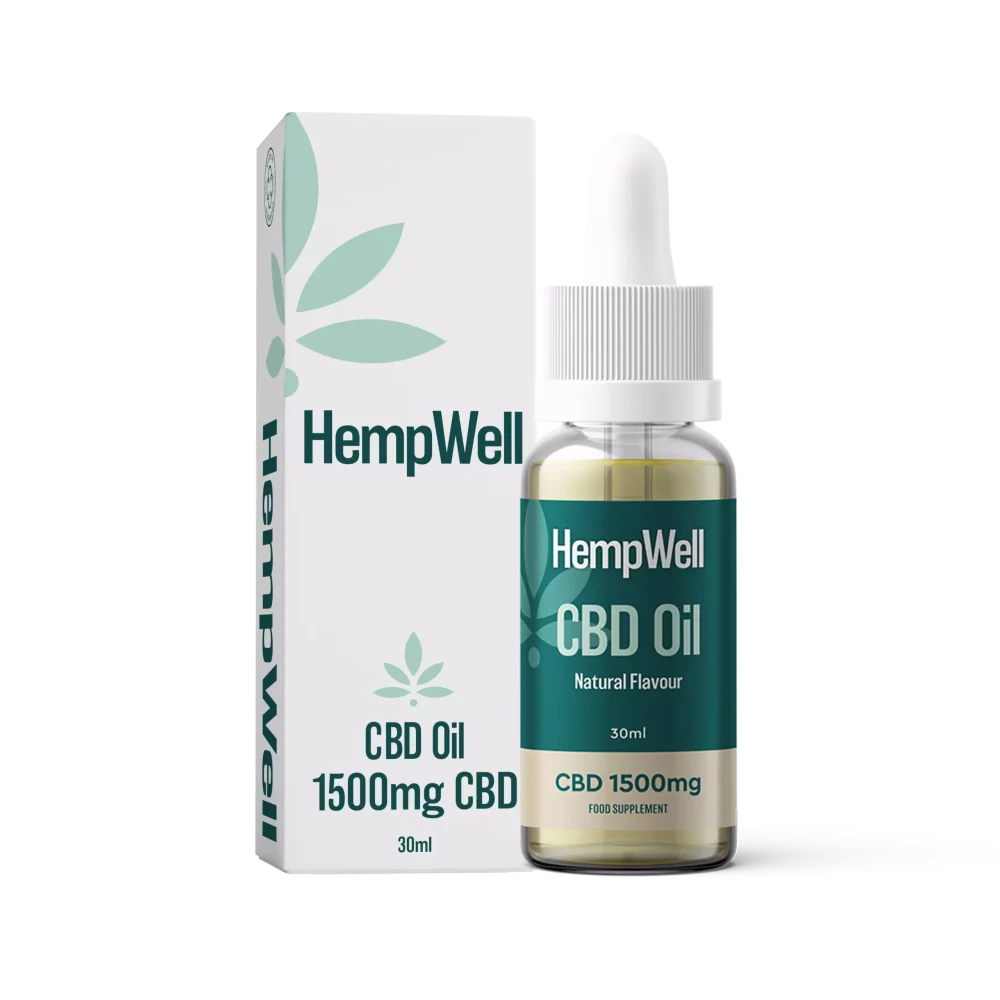
CBD oil can have side effects, but for most adults taking it as a food supplement they are mild, uncommon and dose-related. Across placebo-controlled trials the effects that show up more often with CBD than with a dummy are tiredness or drowsiness, loose stools, changes in appetite, and, at the high doses used as prescription medicine, changes in liver blood tests. CBD is not intoxicating and does not cause dependence. The people who should be careful are those taking other medicines, and anyone pregnant, breastfeeding or trying to conceive.
That is the honest summary, and the rest of this guide shows the evidence behind it: what the clinical trials and the one large consumer study actually found, how the dose you take compares with the doses in those studies, which medicines matter, what to do if you notice a side effect, and the questions we are asked most, from “will it make me sleepy” to “can I drink alcohol with it”. We make our own CBD oils at our laboratory in York Science Park, with Professor Mike Barnes, a consultant neurologist, as our scientific adviser.
Table of Contents
- The common side effects of CBD oil
- What the evidence says, dose by dose
- CBD and the liver: what is known in 2026
- CBD and other medicines
- Who should not take CBD
- How to reduce the chance of side effects
- What CBD does not do
- How we do it at HempWell
- Frequently asked questions
The common side effects of CBD oil
Three large reviews of the clinical data agree on the short list. A 2017 review of safety studies concluded that “the often described favorable safety profile of CBD in humans was confirmed”, and that “the most commonly reported side effects were tiredness, diarrhea, and changes of appetite/weight” (Iffland and Grotenhermen, 2017). A phase 1 trial that gave healthy volunteers very large single and repeated doses found “diarrhea, nausea, headache, and somnolence were the most common adverse events”, all “of mild or moderate severity; none were severe or serious” (Taylor et al., 2018). In practice, the side effects people report to us at food-supplement amounts are:
- Drowsiness or tiredness, usually at higher amounts or when starting. Some people take that as a reason to use CBD in the evening.
- Dry mouth, which is common to many cannabinoids and resolves with a drink of water.
- Digestive upset: loose stools or mild nausea, more likely with large amounts of oil on an empty stomach.
- Appetite changes in either direction.
- Light-headedness, consistent with the small drop in blood pressure seen in trials.
Most people notice none of these. When they do, the usual fix is to lower the amount or take it with food, and the effect passes.
What the evidence says, dose by dose
The most important thing to understand about CBD side effects is dose. Almost all of the rigorous safety data comes from prescription CBD used for severe epilepsy at 10mg to 20mg per kilogram of body weight per day: 700mg to 1,400mg a day for a 70kg adult. The Food Safety Authority of Ireland’s guidance for healthy adults taking CBD as a food supplement is to stay under 70mg a day, and most people take a good deal less. The table below puts the studies side by side.
| Study | Who and how much | What was found |
|---|---|---|
| Chesney et al., 2020 (meta-analysis of 12 placebo-controlled trials, 803 people) | Mostly medical doses, many in children with epilepsy on other drugs | “CBD is well tolerated and has relatively few serious adverse effects, however interactions with other medications should be monitored carefully.” Liver-test changes, sleepiness and sedation “were limited to childhood epilepsy studies”. Outside those, “the only adverse outcome associated with CBD treatment was diarrhoea”. |
| Devinsky et al., NEJM, 2017 | Children with Dravet syndrome, 20mg/kg/day | More diarrhoea, vomiting, fatigue, fever, somnolence and “abnormal results on liver-function tests” than placebo |
| Florian et al., JAMA Internal Medicine, 2025 (US FDA trial) | 201 healthy adults, 5mg/kg/day (about 350mg a day) for 4 weeks | 8 of 143 on CBD (5.6%) had liver enzymes more than three times normal, none on placebo; no effect on thyroid or testosterone hormones |
| Watkins et al., 2023 | 839 everyday CBD users, average 50mg a day, blood tests | Raised liver enzymes in 9.1%, “not significantly different” from the general adult population (8.9%); “no significant association between CBD dosage” and liver tests |
| Babalonis et al., 2022 | Healthy adults, single doses of 200mg to 800mg | “Oral CBD was safe and well tolerated, producing small decreases in blood pressure” |
| Spindle et al., 2020 | Healthy adults, 100mg oral or inhaled | No cognitive or motor impairment; oral CBD indistinguishable from placebo |
Read together, the pattern is clear. Side effects rise with dose, the serious ones appear at medical doses several times above food-supplement amounts and mostly in people on other drugs, and at the amounts sold as supplements the evidence we have points to tolerability. It is not the same as proof of long-term safety at any dose, which is why the European Food Safety Authority has asked for more data before authorising CBD as a novel food, and why we say so plainly rather than promising CBD is risk-free.

CBD and the liver: what is known in 2026
This is the side effect that deserves the most careful reading, because the headlines are often based on the highest-dose studies. CBD is processed by the liver, and at prescription doses it can raise liver enzymes, which is why patients on prescription CBD have blood tests. The 2025 FDA trial is the first to test a dose close to what heavy consumers take, around 350mg a day, and it found enzyme rises in about one in 18 healthy adults over four weeks, with none on placebo; the authors called for “further investigation on the long-term effects of CBD use” and “the safety of lower doses commonly used by consumers”. The consumer study a year earlier, with an average of 50mg a day, found no excess of abnormal liver tests compared with the general population. Those two findings are not in conflict: they bracket the dose. At 50mg a day the signal is not visible; at 350mg a day it is. The sensible conclusions are to stay within the FSAI’s guidance, to avoid stacking several CBD products, and, if you have a liver condition or take medicines that affect the liver, to talk to your GP before starting and to mention CBD at any blood test.
CBD and other medicines
CBD is broken down by the same liver enzyme families, principally CYP3A4 and CYP2C19, that handle many prescription medicines, so it can in principle raise or lower the level of another drug. How much this matters at supplement doses is not well studied; the clearest data again come from epilepsy. A review of six interaction trials of prescription CBD concluded there was “an overall low potential for DDIs between CBD and other ASDs, except for CLB”, meaning clobazam, where CBD raised the levels of both drugs’ active metabolites (Patsalos et al., 2020). The meta-analysis quoted above found that the sedation and liver-test changes in children’s trials were likely interactions with clobazam or sodium valproate.
The groups to be most careful with, because the margin for error is small, are people taking anticoagulants such as warfarin, anti-epileptic drugs, sedatives and sleeping tablets, immunosuppressants, and any medicine that comes with a “do not take with grapefruit” warning, since grapefruit affects the same enzymes. If you take regular medication, the right order is: speak to your GP or pharmacist first, start low, and leave a gap of a few hours between CBD and your medicine while you see how you get on. Our FAQ answer on taking CBD with medication and our guide to whether CBD is safe cover the practical side.
Who should not take CBD
The UK Food Standards Agency’s precautionary advice, which we apply to our Irish customers as well, is that CBD food supplements are not recommended for children under 18, people taking any medication, people trying to conceive, and anyone pregnant or breastfeeding, because the safety data in those groups do not exist. We would add anyone with a diagnosed liver condition, who should have a doctor’s agreement first. CBD creams and balms applied to the skin are a separate case: very little CBD reaches the bloodstream from a topical, and they are regulated as cosmetics rather than foods.
How to reduce the chance of side effects
- Start low and build slowly. A few milligrams once a day for the first week, then increase in small steps. Our CBD dosage guide gives a schedule.
- Take it with food. CBD absorbs better with a meal, which also softens any digestive upset.
- Keep it to one product at a time. Oil plus gummies plus a vape adds up quickly and makes it impossible to tell what caused what.
- Take it in the evening if it makes you drowsy, and do not drive until you know how it affects you; see our guide to driving on CBD oil in Ireland.
- Use a product with a lab report. Unwanted effects from “CBD” are often from what else is in the bottle, including THC or more CBD than the label claims. Ours are on our lab reports page.
- If a side effect appears, lower the amount or stop. The effects above fade within a day or two. Anything beyond mild and short-lived, see your GP.
What CBD does not do
It does not get you high: the World Health Organization found CBD “was not found to have psychoactive properties”, and in trials people taking oral CBD could not tell it from placebo; our guide to whether CBD gets you high has the detail. It does not cause dependence or withdrawal: the WHO review found it “presents no potential for abuse or dependence”, and people who stop taking it report nothing more than the return of whatever they were taking it for. It does not fail a drug test, provided the product is THC-free, as our guide to CBD and workplace drug tests in Ireland explains. And a THC-free CBD product cannot cause an overdose in the sense people mean the word: there is no recorded case of a fatal CBD overdose, and the dose-limiting effects at very high amounts are drowsiness and diarrhoea.
How we do it at HempWell
- Known content, every time. Each product is independently lab tested for CBD content and for THC, heavy metals, pesticides and residual solvents, with the certificate on our lab reports page. You cannot manage a dose you do not know.
- THC-free by design. Our Pure CBD Oil range is isolate in organic MCT oil; our Broad Spectrum range has the THC removed. That removes the one ingredient that reliably causes unwanted effects.
- Clear strengths and a starting point. Oils from 500mg to 2000mg per 30ml bottle so you can start low, with a graduated pipette, and a dosage guide that tells you how.
- Medical oversight. Our health content is reviewed by Professor Mike Barnes, consultant neurologist and our scientific adviser.
If you are unsure whether CBD is right for you, ask our customer care team; we would rather talk you out of a purchase than have you take something that does not suit you.
Frequently asked questions
Does CBD make you sleepy?
It can, particularly at higher amounts or when you first start; somnolence is one of the more consistent findings in trials. At low amounts most people notice nothing. If it does make you drowsy, take it in the evening and do not drive until you know how you respond.
Can CBD lower blood pressure?
Slightly. A placebo-controlled study of 200mg to 800mg found small decreases in blood pressure. If you take blood-pressure medication or are prone to light-headedness, start very low and speak to your GP.
Can CBD cause anxiety?
CBD itself is not associated with anxiety in trials; the opposite effect is what is being studied. Feeling on edge after a “CBD” product usually points to THC in the product, or to a high-caffeine CBD coffee or vape routine rather than the CBD.
Can you overdose on CBD?
Not in the way the word is usually meant. Trials have given healthy adults up to 6,000mg at once with only mild-to-moderate effects such as diarrhoea and drowsiness, and there is no recorded fatal CBD overdose. Large regular amounts can affect liver tests, which is a reason to stay within the FSAI’s guidance rather than a reason to fear a single large dose.
Can I drink alcohol with CBD?
There is little research on the combination. Both can cause drowsiness, so the cautious approach is to avoid alcohol while you are finding your amount, and never to rely on CBD to offset drinking before driving.
Is CBD addictive?
No. The WHO’s expert committee found CBD presents no potential for abuse or dependence, and stopping it does not cause withdrawal.