
CBD oil is good for fewer things than the internet claims and more than the sceptics allow. As a medicine, purified CBD is licensed across the EU for three rare forms of epilepsy, and for nothing else. As a food supplement, the kind sold legally in Ireland, it has small, mostly short-term trials suggesting it can take the edge off acute anxiety and modestly improve measured sleep, a well-documented safety profile at ordinary amounts, and two good trials showing it does nothing for arthritis pain taken by mouth. What it is used for in practice, by most of our Irish customers, is a daily routine for calm, evenings and recovery, with topicals for sore muscles and joints. This guide separates the evidence from the marketing so you can decide whether it is worth trying.
We cover what CBD oil is, the honest evidence league table, what the regulators say, how to choose a product in Ireland, and who should not take it. We make our CBD at our laboratory in York Science Park from hemp grown on our own EU farm, and our scientific adviser is a consultant neurologist.
Table of Contents
- What CBD oil is
- What CBD oil is good for: the evidence, ranked
- The one thing it is proven to treat
- Anxiety, stress and sleep
- Pain, joints and muscles
- Skin
- What CBD oil is not good for
- Choosing a CBD oil in Ireland
- Safety and who should not take it
- How we do it at HempWell
- Frequently asked questions
What CBD oil is
CBD (cannabidiol) is one of more than a hundred compounds in the hemp plant. It is not intoxicating, it is not a controlled drug in Ireland, and it does not turn into THC in the body. A CBD oil is CBD extracted from hemp and dissolved in a carrier oil, usually MCT coconut oil, measured with a pipette and held under the tongue. In Ireland it is sold as a food supplement under EU novel food rules, which means it must be THC-free and cannot carry health claims. Our explainers on what CBD is and whether CBD is legal in Ireland cover the background; this guide is about what it actually does.
What CBD oil is good for: the evidence, ranked
| Use | Evidence | Honest summary |
|---|---|---|
| Rare childhood epilepsies | Strong (licensed medicine) | Prescription CBD works; a supplement is not that medicine |
| Acute anxiety (a stressful event) | Moderate, small trials, single large doses | 300mg to 600mg of pharmaceutical CBD reduced anxiety in the lab; supplement amounts untested |
| Sleep | Early, one modern trial | Small gains in measured sleep efficiency and well-being; insomnia severity unchanged |
| Muscle and joint comfort (topical) | Weak; one small positive trial in nerve pain | Cooling creams feel good and help you keep moving; no proof CBD itself is doing it |
| Skin (acne, oiliness) | Laboratory only | Interesting cell studies; no good human trial |
| Arthritis pain (oral) | Two good trials, both negative | No better than placebo at 20 to 30mg or 600mg a day |
| Everything else (depression, cancer, diabetes, “immunity”) | None usable | Claims to avoid |
The one thing it is proven to treat
Purified CBD under the brand name Epidyolex was authorised in the EU on 19 September 2019 as an add-on treatment for seizures in Lennox-Gastaut syndrome, Dravet syndrome and tuberous sclerosis complex (European Medicines Agency). It is prescribed at 10 to 20mg per kilogram of body weight a day, many times the supplement amount, with liver monitoring. It is the proof that CBD is pharmacologically real; it is also the reason supplement claims should be modest, because the same compound at a tenth of the dose in a different product has not been shown to do the same things.
Anxiety, stress and sleep
- Anxiety. In a placebo-controlled study, 600mg of CBD before a simulated public-speaking test “significantly reduced anxiety, cognitive impairment and discomfort in their speech performance” in people with social anxiety disorder (Bergamaschi et al., 2011). A later study found 300mg worked where 100mg and 900mg did not, “a dose-dependent inverted U-shaped curve” (Zuardi et al., 2017). Those are single pharmaceutical doses in a lab, not a daily supplement, and a 2015 review concluded the evidence “is currently limited to acute dosing” (Blessing et al., 2015). Our guide to how much CBD for anxiety goes through the numbers.
- Sleep. The best recent trial gave 30 adults with insomnia 150mg of CBD or placebo nightly for two weeks: insomnia severity “did not differ between treatments”, but the CBD group “had superior objective sleep efficiency after 2 weeks” and reported greater well-being (Narayan et al., 2024). Modest, short, but real. Our guide to CBD sleep drops covers how to use it in an evening routine.
- Everyday stress. This is where most people actually use CBD, and where there is no trial to quote. What we can say is that it is not sedating at supplement amounts, not habit-forming, and a daily routine is easy to judge for yourself over a month.
Pain, joints and muscles
This is where honesty matters most, because pain is the biggest reason people search for CBD. Taken by mouth, CBD has failed its two best placebo-controlled trials in painful joints: 20 to 30mg a day for 12 weeks in hand osteoarthritis produced “neither clinically nor statistically significant effects” (Vela et al., 2022), and 600mg a day added to paracetamol in knee osteoarthritis was no better than placebo, with more side effects (Pramhas et al., 2023). Applied to the skin, there is one small positive trial in nerve pain (Xu et al., 2020) and nothing in arthritis.
What a cooling CBD cream or balm does reliably is feel good on a sore knee, back or shoulder, through the menthol and the massage, and make it easier to keep active, which is what Irish guidance says matters. That is a comfort product, and we sell it as one. Our guides to CBD for knee pain and CBD for sciatica go through the evidence and the HSE’s advice.
Skin
CBD has been shown in the laboratory to reduce oil production and inflammation in human skin cells, which is why it appears in cleansers and creams for oily or blemish-prone skin (Oláh et al., 2014). There is no good human trial yet. As a cosmetic ingredient alongside a well-formulated base it is reasonable; as a treatment for acne, eczema or psoriasis it is unproven, and those conditions have pharmacy and GP options with evidence. Our CBD and skin guide covers the practical side.
What CBD oil is not good for
- Depression. No controlled human trial supports it, and it is not a substitute for GP care.
- Cancer, diabetes, heart disease, dementia, “immunity”. Cell and animal studies only. Any product making these claims is breaking Irish and EU law.
- Getting high. It does not, and a legal Irish product contains no THC; our guide on whether CBD gets you high explains.
- Replacing a medicine. Never stop prescribed treatment for a supplement.
Choosing a CBD oil in Ireland
- THC-free, with a lab report. In Ireland any THC makes a product a controlled drug. Ask for the certificate of analysis showing THC not detected; ours are on our lab reports page.
- Isolate or broad spectrum. Isolate is CBD alone, flavourless and the simplest to measure; broad spectrum keeps other hemp compounds with the THC removed and tastes of hemp. Our guide to isolate versus broad spectrum compares them.
- Strength is per bottle, not per serving. A 1000mg oil in 30ml gives about 33mg per 1ml pipette and about 8mg per quarter pipette. Our pipettes are graduated so you measure in ml rather than counting drops. See choosing a strength.
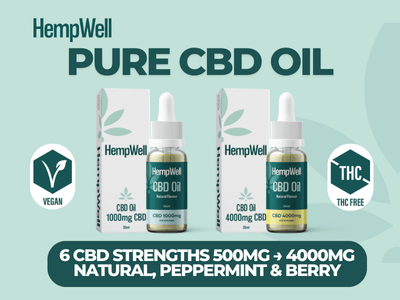
- Price per mg. Our Pure CBD Oil 1000mg is €39.99, the 500mg €19.99, delivered across Ireland by DPD and free over €50.
- Start low. 10mg to 20mg a day with food, held for a week or two, within the 70mg-a-day guidance for healthy adults; our dosage guide walks through it.
Safety and who should not take it
At supplement amounts CBD is well tolerated: a meta-analysis of placebo-controlled trials found the serious side effects (liver test changes, sedation) “were limited to childhood epilepsy studies” at pharmaceutical doses alongside other medicines (Chesney et al., 2020). The common mild effects are tiredness, dry mouth and loose stools. The regulators’ precautionary advice is that CBD supplements are not for under-18s, pregnancy, breastfeeding, anyone trying to conceive, or anyone on medication without a pharmacist’s advice; blood thinners, anti-epileptics and sedatives are the groups that matter. Our guides to CBD oil side effects and CBD and medication interactions go into both.
How we do it at HempWell
- Our own supply chain. Hemp from our own EU farm, extracted and bottled at our laboratory in York Science Park, THC-free, independently lab tested.
- No health claims. We sell CBD as a food supplement and cosmetics, and we quote the trials, including the negative ones.
- Measured servings. Exact mg per ml and a graduated pipette, so you can judge it properly.
- Medical oversight. Our health content is written with Professor Mike Barnes, a consultant neurologist, as our scientific adviser.
Browse our Pure CBD oils and broad-spectrum oils, or try the formats first with a starter pack.
Frequently asked questions
What is CBD oil good for?
As a medicine, three rare epilepsies. As a supplement, the evidence is early and small: acute anxiety at large doses, modest sleep gains, and comfort from topicals. It has not worked for arthritis pain taken by mouth. Most people use it as a daily routine for calm and evenings.
What are the benefits of CBD oil in Ireland?
The same as anywhere: a non-intoxicating, non-habit-forming supplement with a good safety record at ordinary amounts. The Irish difference is that a legal product must be THC-free, so check the lab report.
Does CBD oil help with pain?
Oral CBD did not beat placebo in the two best joint-pain trials. A cooling CBD cream is a comfort product that can help you keep moving; it is not a painkiller.
Is CBD oil good for anxiety?
Single large doses reduced anxiety in laboratory studies, and more was not better. Daily supplement amounts have not been tested properly. If anxiety affects your daily life, see your GP first.
How long does CBD oil take to work?
Under the tongue, 15 to 45 minutes for any immediate effect; for a daily routine, give it one to two weeks at a steady amount. Our guide to how long CBD takes to work explains.
Is CBD oil safe to take every day?
At supplement amounts, for healthy adults, the trial record is reassuring. Stay within 70mg a day, buy THC-free with a lab report, and check with a pharmacist if you take medication.