
There is no single best CBD oil in Ireland, because “best” depends on what you want from it, how much you plan to take and how much hemp flavour you can live with. There is, however, a clear way to tell a good bottle from a poor one, and most of it comes down to five things you can check before you pay: the type of extract, the strength written as milligrams per millilitre, the carrier oil, an independent lab report you can actually open, and a seller whose THC position matches Irish law. Get those five right and the rest is personal preference.
This guide walks through each of them in the order that matters, explains what the law in Ireland does and does not allow, shows how to compare price fairly and sets out how we make our own oils so you can judge us by the same standard. It is written for someone buying CBD oil for the first time, or buying again after a bottle that disappointed.
Table of Contents
- What “best” actually means for a CBD oil
- Isolate or broad spectrum: the first decision
- Strength: think in milligrams per millilitre
- The carrier oil and what else is in the bottle
- Lab reports: the check that separates good from bad
- THC, novel food and the law in Ireland
- Comparing price: cost per milligram
- Red flags that should end the sale
- How we make our CBD oil
- Frequently asked questions
What “best” actually means for a CBD oil
Most people start by comparing the big number on the front of the bottle, and most people are comparing the wrong thing. A 2000mg oil is not better than a 1000mg oil; it is simply twice as concentrated, which only matters once you know how much CBD you intend to take each day. The things that decide whether a bottle is any good are quieter: whether the CBD content on the label is what is in the bottle, whether the THC has genuinely been removed, whether the extract type suits you, and whether the seller is honest about what CBD is in Ireland, which is a food supplement and not a medicine.
So the useful definition of “best” is this: an oil whose label is accurate, whose testing you can see, whose extract and strength fit the way you will use it, and which comes from a seller who will still be there next year. That rules out a surprising share of what is sold online, and it is the standard we hold our own range to.
Isolate or broad spectrum: the first decision
Every CBD oil sold legally in Ireland is one of two things. CBD isolate oil contains purified cannabidiol, typically 99% or more pure, dissolved in a carrier oil. Broad spectrum oil starts from the whole hemp extract, keeps the minor cannabinoids and terpenes, and has the THC removed. The third type you will see advertised, full spectrum, keeps the THC and cannot be sold as a food in Ireland, for reasons covered below.
For a first bottle we usually suggest isolate. It is the most predictable form, because the only active ingredient is the one on the label; it is close to tasteless, so it goes under the tongue or into a coffee without the earthy note that puts some people off; and it is the easiest to measure. Broad spectrum is the choice for people who want the fuller plant profile. Some customers notice more from it at the same strength, some notice no difference, and the research behind the “entourage effect” is suggestive rather than settled. Our guide to isolate versus broad spectrum CBD oil goes through the evidence properly; the short version is that neither is wrong, and you can always switch once you know your daily amount.
Strength: think in milligrams per millilitre
The strength on the label is the total CBD in the bottle, and on its own it tells you very little, because bottles come in different sizes. The number that matters is milligrams of CBD per millilitre of oil, which is the total divided by the bottle size. All of our oils are 30ml, so the maths is simple: 500mg is about 17mg per ml, 1000mg is 33mg per ml, 1500mg is 50mg per ml, 2000mg is 67mg per ml and 4000mg is 133mg per ml. A 10ml bottle labelled 1000mg is three times as concentrated as our 1000mg, and a 50ml bottle labelled 1000mg is weaker. Always compare per millilitre.
Then work backwards from the amount you plan to take. Most of our customers start at 10 to 20mg a day and settle somewhere around 33mg, 50mg or 66mg, which happens to be one full 1ml pipette of the 1000mg, 1500mg and 2000mg oils respectively. A beginner is well served by the 500mg or 1000mg; a higher-strength bottle makes sense once you know your amount and want fewer millilitres per day. Ireland follows the same 70mg-a-day guideline for healthy adults that we work to across all our ingestible products, so there is no reason to buy more concentration than that calls for.
Two practical points. First, measure in millilitres, not drops. Drops vary with the thickness of the oil and the angle of the pipette, which is why our bottles ship with a graduated pipette marked in quarter millilitres; a quarter pipette of the 1000mg oil is about 8mg. Second, if a product states its strength only as a percentage, convert it: 5% CBD in a 30ml bottle is 1500mg, and 10% is 3000mg. Our guide to choosing the right strength of CBD oil has a longer worked example, and the dosage guide covers how to build up.
The carrier oil and what else is in the bottle
CBD extract is thick and resinous, so every oil dissolves it in a carrier. The two you will meet are MCT oil, which is a fraction of coconut oil with almost no taste, and hemp seed oil, which is pressed from the seeds, carries a nutty green flavour and contains no CBD of its own. Neither is better; MCT suits isolate because it keeps the taste neutral, and hemp seed oil suits broad spectrum because its flavour sits naturally alongside the terpenes. Olive oil and other carriers exist but are less common. Our post on hemp oil and CBD oil explains why a bottle labelled “hemp oil” at a supermarket price may contain no CBD at all.
Beyond the carrier, the ingredient list should be short. A natural flavouring is fine. Added botanicals can be a genuine feature, as in our SleepWell oil, which pairs CBD isolate with valerian root, passionflower and lavender, but they should be named and quantified on the label rather than hidden behind the word “proprietary”. Be wary of long lists of vitamins, “nano” or “water-soluble” claims with no explanation, and anything that does not state the carrier at all.
Lab reports: the check that separates good from bad
This is the check most buyers skip and the one that matters most. An independent laboratory report, sometimes called a certificate of analysis, shows what is actually in the bottle: the CBD content, the other cannabinoids, and whether THC was detected. Good reports also screen for heavy metals, pesticides and microbes. The reason it matters is that labelling in this market has a poor record. A study published in JAMA tested 84 CBD products bought online and found that only about 31% contained CBD within 10% of the labelled amount, and that THC was detected in 21% of them (Bonn-Miller et al., JAMA, 2017). That study was American, but there is no reason to assume the online market serving Ireland is cleaner.
What to look for in a report: the laboratory’s name and accreditation, the product it refers to, a date, a CBD figure that matches the label within a sensible tolerance, and THC reported as not detected or below the laboratory’s reporting limit. A QR code that opens an image of a report with no product name on it is not a lab report. We publish ours centrally on our lab reports page rather than one per product page, and our explainer on what CBD lab testing covers shows you how to read one line by line.
THC, novel food and the law in Ireland
Two pieces of Irish law decide whether an oil can be sold here, and sellers often blur them. The first is the Misuse of Drugs Act. The Food Safety Authority of Ireland is clear that CBD itself is not a controlled substance, but that THC is a narcotic, and that apart from hemp seed products “there is no regulatory threshold or tolerance for the presence of THC in food”, so a food “containing any level of THC is classed as a narcotic drug” (FSAI, CBD and other hemp products). The 0.2% figure quoted on many websites is the limit for THC in the hemp crop growing in the field, not a permitted level in a bottle. In practice that means the best CBD oil for an Irish buyer is one tested as THC-free, which is why we make no full spectrum products for any market. Our guide to whether CBD is legal in Ireland covers the detail, including what it means for driving and workplace drug tests.
The second is novel food law. Under EU Regulation 2015/2283, CBD extracts are classed as novel foods, which means they need authorisation before they can be marketed as food, and no CBD product has yet completed that process. The European Food Safety Authority paused its assessments in 2022 after concluding that the applications had data gaps on CBD’s effects on the liver, the digestive and endocrine systems and the nervous system, and it is still waiting for that data. That is the honest position: CBD oils are sold across the EU while the authorisation question remains open, and no seller in Ireland can claim its oil is “fully approved”. A seller that says otherwise, or that makes medical claims for a food supplement, is telling you something about how much to trust the rest of its label.
Comparing price: cost per milligram
Because bottles differ in size and strength, the only fair comparison is price per milligram of CBD. Divide the price by the total milligrams. As a worked example from our own range, a 500mg broad spectrum oil at €24.99 is about 5 cents per milligram, and a 2000mg isolate oil at €69.99 is about 3.5 cents per milligram, so the stronger bottle is cheaper per milligram and lasts longer, which is the usual pattern across brands. A subscription takes a further 20% off. That said, do not buy a 4000mg bottle to save money if you will take 20mg a day; a 500mg bottle used up is better value than a 4000mg bottle that passes its best-before date. If you are wondering why CBD costs what it does at all, our post on the price of CBD explains where the money goes, from the farm to the laboratory testing.
Red flags that should end the sale
- No lab report, or a report you cannot match to the product. This is the single clearest sign to walk away.
- Medical claims. Any seller promising to treat, cure or prevent a condition is breaking the rules for food supplements and is not a careful business.
- “Full spectrum” sold as food in Ireland. See the law section above.
- Strength given only as a percentage, or only as a number of drops. Both hide the real concentration.
- No carrier oil named, or “hemp oil” sold at a price that suggests it contains no CBD.
- Marketplace listings with no identifiable company. Buy from a seller with a registered business, a physical address and a returns policy. Our guide to where to buy CBD in Ireland covers the difference between a specialist and a reseller.
How we make our CBD oil
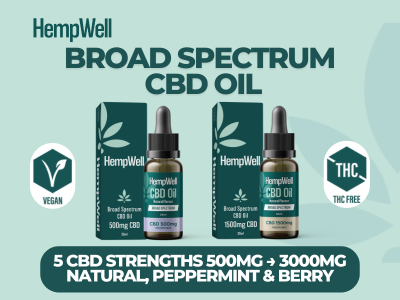
We would rather you judged us by the checklist above than by our own description, so here is how our range measures against it. The hemp is grown on our own farm in Europe, which is why we can describe the crop rather than buy extract of unknown origin; the story is on our hemp farm page. The extract is purified into isolate for the Pure CBD Oil range, blended in organic MCT oil, or has its THC removed for the Broad Spectrum range, blended in hemp seed oil. Both come in Natural, Peppermint and Mixed Berry, in strengths from 500mg to 4000mg per 30ml bottle, each with a graduated pipette. The oils are made and bottled by hand at our laboratory in York Science Park, each product is independently lab tested with the reports on our lab reports page, and the range was developed with guidance from our Scientific Advisor, Professor Mike Barnes. More than 2,000 verified customers have reviewed it. We deliver across Ireland with DPD, free over €50, dispatched the same day on orders before 1pm, and subscriptions save 20%.
If you are new to CBD oil altogether, two short reads will help once the bottle arrives: how to take CBD oil and what the research says about side effects, including the point that CBD can interact with some medicines, so anyone on prescription medication should read our interactions guide or speak to their pharmacist first.
Frequently asked questions
What strength CBD oil should a beginner buy in Ireland?
A 500mg or 1000mg bottle in 30ml. Both let you start at 10 to 20mg a day with a quarter or half pipette and build up slowly. Buy a stronger bottle once you know the amount you settle on.
Is broad spectrum CBD oil legal in Ireland?
Yes, provided the THC has genuinely been removed and the lab report shows it as not detected. Full spectrum oil, which keeps the THC, cannot be sold as a food in Ireland at any level of THC.
How do I know a CBD oil is THC-free?
Open the independent lab report and look for the THC line: it should read “not detected” or below the laboratory’s reporting limit. If there is no report, assume nothing.
Does a higher price mean a better CBD oil?
Not by itself. Compare price per milligram of CBD, then check the lab report and the extract type. A dear bottle with no report is a worse buy than a cheaper one with a clear one.
Is CBD oil approved by the FSAI?
No CBD extract has yet been authorised as a novel food in the EU, so no seller can honestly say its oil is approved. CBD itself is not a controlled substance in Ireland; THC is, which is why THC-free testing matters.
Can I buy CBD oil in a pharmacy in Ireland?
Some pharmacies and health shops stock it, as do specialist online sellers. Wherever you buy, the same checks apply: extract type, strength per millilitre, carrier, lab report and the seller’s THC position.